Project management
your agents actually follow.
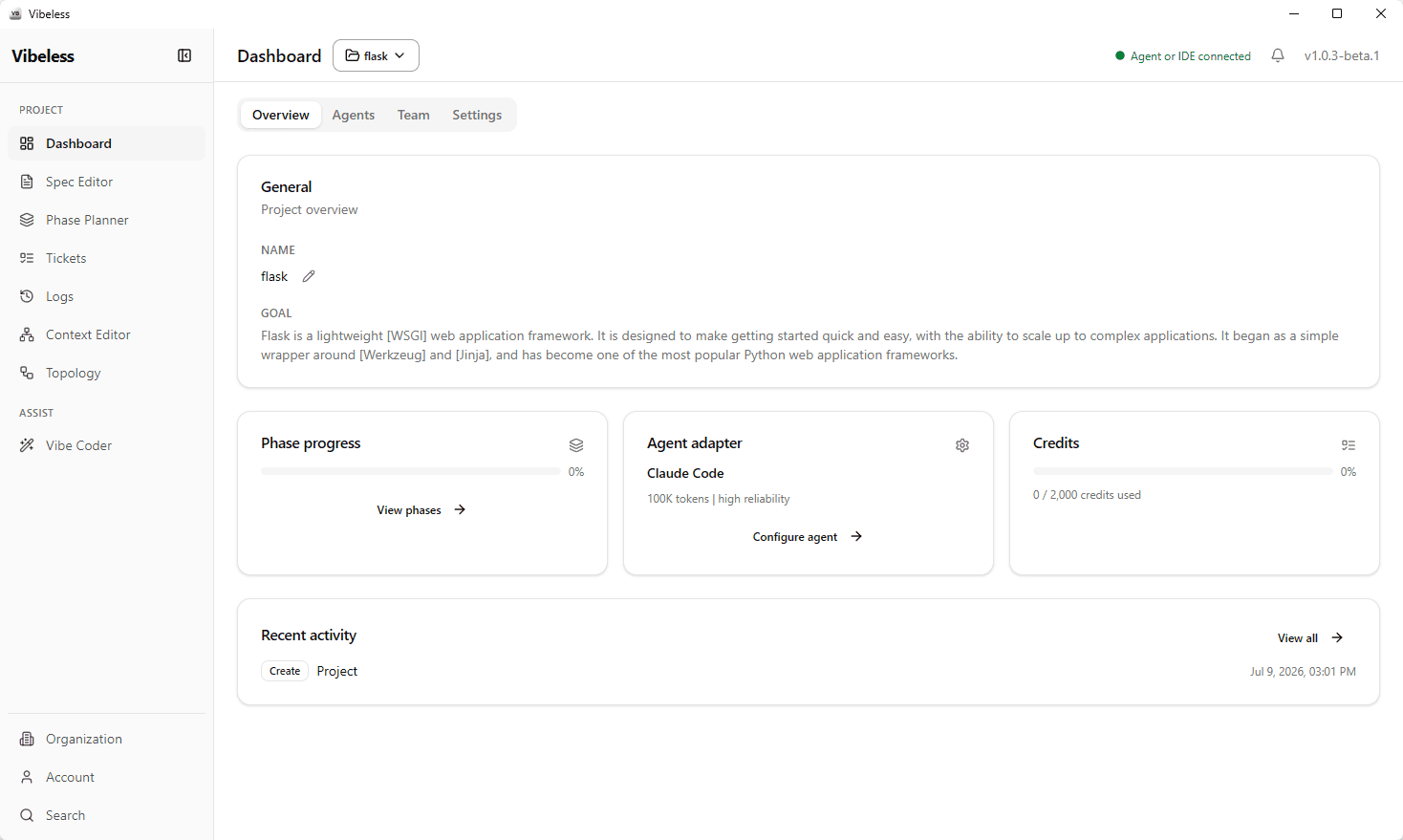
Govern your architecture, goals, constraints, and specs in one place, outside your agent's memory and your repo. They reach every agent, every time.
- Claude Code
- Codex
- Cursor
- OpenCode
- GitHub Copilot
We gave two identical AI agents the same spec. One had Vibeless.
100%
followed the spec over the model's habits. Without Vibeless: 0%.
15×
more tests guarding the architecture.
90%
reviewer score on a change request. Without Vibeless: 76%.
105
tickets, rules and decisions a brand-new session inherited, and acted on.
What a folder of markdown can't do
Built for agent projects that run for weeks, where the plan has to survive every new session.
Decisions that outlive the session
Decisions, rulings and non-goals are kept as records your agent can search. A session next month starts with what you settled today.
Rules your agent can't rewrite
You own the constraints, non-goals, phases and tickets. Agents follow them, log decisions and flag conflicts, but only a person can change the rules.
Drift checks, free
A deterministic drift check, free on every plan, compares changes against your specs, constraints and phase plan and flags divergence before it becomes review debt. Risky actions a ticket doesn't ask for, like a deploy or a force push, raise an alert on every plan. Paid plans add Jev, which checks each finished ticket for scope drift.
Works inside the agent you already use
One click connects Claude Code, Codex, Cursor or OpenCode to the local MCP server and installs hooks, so every session starts with the project record. GitHub Copilot, Antigravity and Gemini CLI (experimental) connect the same way; recording from their live sessions is not yet verified.
New to specs? Start here
VibeCoder, the guided setup, walks vibe coders and junior devs through a real spec, architecture and phase plan before the first line of code. VibeCoder uses credits on paid plans, with a 7-day free trial.
Light and dark themes
Vibeless follows your operating system's setting by default; choose System, Light or Dark under Account → Appearance → Theme.
How it works
Get started in three simple steps.
Define your project
Write down the goal, spec, architecture, constraints and non-goals, or import an existing codebase. New to specs? VibeCoder builds them with you.
Connect your agent
One click connects your agent (Claude Code, Codex, Cursor, OpenCode, GitHub Copilot, Antigravity or Gemini CLI) to the local MCP (Model Context Protocol) server and installs its hooks.
Every session starts informed
Each new session opens with your rules and past decisions. The agent logs new decisions as it works, and the drift check shows where the code has left the plan.
Give your next session the whole project.
Every governance feature is free on one project. No credit card required.